Discord



'/%3e%3c/g%3e%3cdefs%3e%3clinearGradient%20id='paint0_linear_91_7909'%20x1='2.80579'%20y1='2.93848'%20x2='14.3838'%20y2='4.55824'%20gradientUnits='userSpaceOnUse'%3e%3cstop%20stop-color='%231198B9'/%3e%3cstop%20offset='0.0001'%20stop-color='%230F9DB8'/%3e%3cstop%20offset='1'%20stop-color='%232468C0'/%3e%3c/linearGradient%3e%3c/defs%3e%3c/svg%3e)
'/%3e%3c/g%3e%3cdefs%3e%3clinearGradient%20id='paint0_linear_91_7889'%20x1='4.20874'%20y1='4.40771'%20x2='21.5757'%20y2='6.83736'%20gradientUnits='userSpaceOnUse'%3e%3cstop%20stop-color='%231198B9'/%3e%3cstop%20offset='0.0001'%20stop-color='%230F9DB8'/%3e%3cstop%20offset='1'%20stop-color='%232468C0'/%3e%3c/linearGradient%3e%3c/defs%3e%3c/svg%3e)


















The United States is the easiest place in the world to buy a VPS and one of the hardest places to buy the right one. Every provider on earth has a US region, most have four, and the location dropdown tells you almost nothing about what you are getting. Some of those regions are owned racks in a carrier hotel. Some are a few cabinets rented inside somebody else's facility. At least two on the shortlist most people work from are a management layer over a third party's cloud.
The choice that actually matters is not which provider, it is where in the country and on whose network. A server in Ashburn is superb for the East Coast and mediocre for Portland. A server in central Utah is nobody's fastest option and almost everybody's second fastest, which for a national audience is usually the better trade. Nobody puts that on a pricing page.
This is a ranking of ten providers with genuine US infrastructure, judged on network, egress terms, price per core and billing behaviour. We are CloudBlast, we run Salt Lake City, and we are first on this list. Everything below is a spec or a price you can verify on the provider's own site, and where a competitor beats us we say so.
How We Ranked These Providers
Where the capacity actually is. A "US East" label covers everything from Ashburn to Secaucus to Atlanta. The building and its carrier mix decide your latency, not the state.
Egress terms, not the bandwidth number. The US is the one market where egress pricing is genuinely competitive, and it is also where the surprise bills get written. Unmetered, a large included allowance and per-GB metering are three different products.
Price per core against real specs. We normalise to a small production box, roughly 2 to 3 cores, 4 GB of RAM and 30 GB or more of NVMe, rather than comparing headline tiers with half a gigabyte of RAM.
Billing granularity. Hourly or per-second billing turns ephemeral infrastructure from a monthly line item into a rounding error. Monthly-only providers are fine for fixed workloads and expensive for everything else.
Whether they own it. Owning racks and buying transit directly is what makes unmetered traffic possible at a low price. Resellers can be excellent, and their floor is still somebody else's ceiling.
We did not rank on the number of US cities. Coverage matters if your users are in one specific metro, and it is a vanity metric if they are spread across the country.
Quick Comparison
Indicative entry pricing as of September 2026.
| Provider | US locations | Entry plan | Price | Traffic |
|---|---|---|---|---|
| CloudBlast | Salt Lake City | 1 vCPU AMD EPYC, 3 GB, 20 GB NVMe | €3.60/mo (€0.0058/h) | 5 to 10 TB, 10 Gbps |
| DigitalOcean | NYC, SFO, ATL and more | 1 vCPU, 1 GB, 25 GB | $6/mo | 1 TB pooled, then $0.01/GiB |
| Vultr | 15 or more metros | 1 vCPU, 0.5 GB, 10 GB | $2.50/mo | 0.5 TB and up |
| Akamai (Linode) | Dallas, Fremont, Newark and more | 1 vCPU, 1 GB, 25 GB | $5/mo | 1 TB pooled |
| Hetzner Cloud | Ashburn, Hillsboro | 2 vCPU, 4 GB | from about $6/mo | 1 TB, then metered |
| AWS Lightsail | All AWS US regions | 1 vCPU, 0.5 GB | $5/mo | 1 TB, then metered |
| Contabo | New York, Seattle, St. Louis | 3 vCPU, 8 GB, 75 GB NVMe | $4.95/mo | 32 TB, 200 Mbit port |
| Hostwinds | Dallas, Seattle | 1 vCPU, 1 GB | from about $5/mo | Unmetered on most plans |
| InterServer | Secaucus NJ, Los Angeles | 1 core slice, 2 GB | about $6/mo | Metered per slice |
| RackNerd | 10 or more US metros | 1 vCPU, 1 GB, 21 GB | about $11.29/year | 1.5 TB |
1. CloudBlast
Best for: national US reach on a 10 Gbps port, when you want one server to serve the whole country rather than three servers to serve three coasts.
Entry plan: VMA11, 1 AMD EPYC core, 3 GB RAM, 20 GB NVMe, €3.60/mo or €0.0058/h.
Our US region is Salt Lake City, and the choice was deliberate. Coastal regions optimise for the coast they sit on: Ashburn is excellent to New York and Boston and unremarkable to Seattle, and Fremont is the mirror image. Salt Lake City sits close to the middle of the national fibre map, which typically puts Denver in the low tens of milliseconds, Los Angeles, the Bay Area and Seattle in the low twenties, Chicago and Dallas around the thirty mark, and the East Coast around fifty. It wins no individual matchup and it loses none badly.
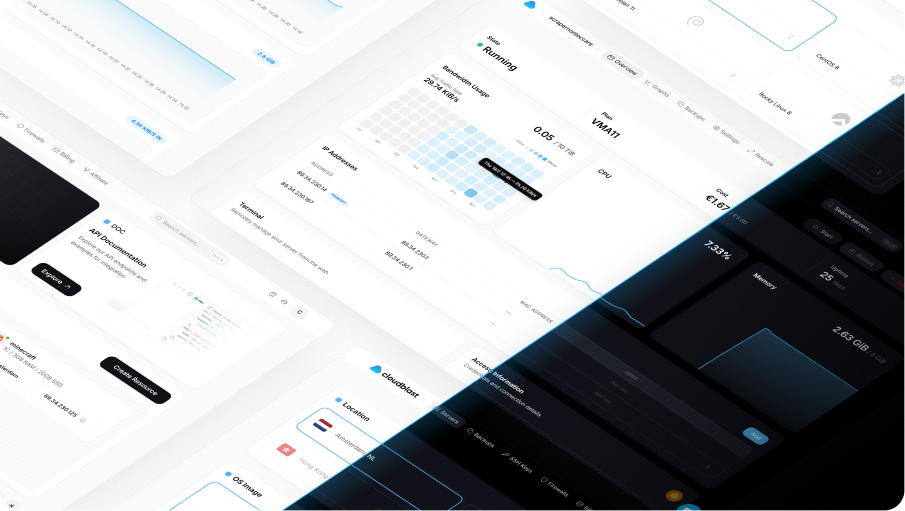
Traffic in Salt Lake City runs on a 10 Gbps port with 5 TB a month included on the three smallest plans and 10 TB from the VMA41 up, and that is the part that changes what you can build. Media delivery, backup targets, package mirrors and game servers get several terabytes of egress in the base price, which on a metered provider at $0.01/GiB is exactly where the surprise bills come from. The same hardware runs in every region: AMD EPYC across all eight plans, NVMe throughout, and always-on DDoS mitigation with up to 2.5 Tbps of scrubbing capacity, included rather than sold as an add-on.
Billing is hourly on every plan, from €0.0058/h on the VMA11 up to €0.1263/h on the VMA81 (16 cores, 64 GB), capped at the monthly price so a full month never costs more than the sticker. Add-ons follow the same model: backups at €0.09/GB, block storage at €0.15/GB, additional IPv4 at €2.50/mo or €0.00347/h. There is a public API and an MCP server if you would rather drive infrastructure from an AI assistant than a dashboard.
What we like: 10 Gbps in the US with 5 to 10 TB included at a budget price point, EPYC and NVMe on every tier, DDoS included, hourly billing with no minimum term, central routing that treats both coasts fairly.
What to watch: one US region, not fifteen. If your users sit in a single East Coast metro and you are chasing the last 20 ms, a provider with an Ashburn or Secaucus presence beats us on that specific number. There is also no managed database or managed Kubernetes product here.
2. DigitalOcean
Best for: teams who want managed Postgres, object storage and App Platform in the same account as their VPS.
DigitalOcean is the default American developer cloud and it earns that reputation on everything except raw compute price. Basic Droplets start at $4/mo, $6 gets 1 GB with 1 TB of outbound transfer, and the box most teams actually deploy (2 vCPU, 4 GB) is $24/mo. That is roughly 4x a comparable machine elsewhere on this list, and the premium buys the surrounding platform plus documentation that is genuinely the best in the industry.
Billing moved to per-second with a 60-second minimum on 1 January 2026, the finest granularity here. The transfer allowance pools across your whole account, which is a materially better model than per-instance caps if you run many small Droplets, with overage at $0.01/GiB.
What we like: per-second billing, pooled transfer, mature managed services, US regions on both coasts and in Atlanta.
What to watch: expensive per core. Egress overage adds up quickly on media-heavy workloads.
3. Vultr
Best for: metro coverage. If you need a box in a specific American city, Vultr probably has one.
Vultr's US footprint is the broadest here, spanning Seattle, Silicon Valley, Los Angeles, Dallas, Chicago, Atlanta, Miami, New Jersey and more. For a latency-sensitive workload with a known geographic audience, that is the single most useful thing on this page.
The tier structure matters more than the price list suggests. Regular Performance from $2.50/mo puts you on shared Intel cores with SATA SSDs, which is a hard sell in 2026. High Performance and High Frequency start around $6/mo and are where you actually want to be, on AMD EPYC or high-clock Xeon with NVMe. Billing is hourly with a 672-hour monthly cap, so a 31-day month costs the same as 28.
What we like: unmatched US metro coverage, bare metal and GPU in the same panel, hourly billing with a cap.
What to watch: the Regular Performance tier is a trap for anyone comparing headline prices. Bandwidth allowances on small plans are modest and overage is billed.
4. Akamai Cloud (Linode)
Best for: predictable pricing and a US panel that has not surprised anyone in fifteen years.
Akamai bought Linode in 2022 and largely left the product alone, which in a year when two providers on this list changed their pricing model counts as a feature. The $5 Nanode is still $5, the 2 GB plan is still $12, and the US regions (Newark, Dallas, Fremont, Atlanta, Chicago, Seattle, Washington DC and others) are long established.
Transfer pools across the account at 1 TB on the entry plan, hourly billing caps at the monthly price, and the API and CLI are solid. The weakness is price per core: shared CPU tiers are underpowered for the money and dedicated tiers start around $36 to $45/mo. Part of what you pay for is Akamai's edge network sitting behind it.
What we like: no price increases through the acquisition, pooled transfer, dependable API and CLI, good US region spread.
What to watch: shared tiers are thin for the price, dedicated tiers are expensive, and documentation got harder to navigate after the rebrand.
5. Hetzner Cloud
Best for: teams already standardised on Hetzner tooling who need a US presence to match their EU one.
Hetzner runs Ashburn, Virginia and Hillsboro, Oregon, both good facilities on good networks. The API and Terraform provider remain the best in this price bracket and the console is fast.
The problem is what happened on 15 June 2026. The price adjustment hit US regions harder than European ones, and the AMD lines took the worst of it: CPX22 went from €7.99 to €19.49 a month, CPX32 from €13.99 to €35.49, with dedicated CCX tiers up between 2.1x and 2.7x. US instances also include 1 TB of traffic rather than the 20 TB European instances get, so the egress model is not the one people remember. If you priced Hetzner US before June, your comparison is stale.
What we like: best-in-class API and Terraform provider, mature private networking and load balancers, two well-placed US regions.
What to watch: the June 2026 increase makes the AMD lines hard to justify on price alone, US traffic allowances are far smaller than in Europe, and new account verification can be slow.
6. AWS Lightsail
Best for: teams already inside AWS who want a fixed-price instance without touching EC2 pricing.
Lightsail is AWS with the complexity removed and most of the flexibility removed with it. Instances start at $5/mo, bundles include a transfer allowance, and everything sits in a real AWS region, so you can peer into a VPC and reach the rest of the platform when you need it. For a small service that must live next to existing AWS infrastructure, that adjacency is the whole argument.
Two things to know. Stopped instances still bill at the full rate, because the disk and IP stay reserved, so only deletion ends the charge. And transfer overage is metered, which on a busy site removes the price predictability that was the reason to choose Lightsail in the first place.
What we like: every US AWS region, VPC peering into the wider platform, bundle pricing that is easy to forecast, strong reliability.
What to watch: stopped instances keep billing, specs are modest for the money, and you inherit AWS billing complexity the moment you step outside the bundle.
7. Contabo
Best for: the most RAM and disk per dollar in the US, when the network is not your bottleneck.
Contabo runs New York, Seattle and St. Louis, and the value proposition matches its European one: Cloud VPS 10 gives you 3 vCPU, 8 GB of RAM and 75 GB of NVMe for $4.95/mo, which nothing else here matches on resource count. For a staging environment, a media library or a memory-hungry self-hosted app, that is unbeatable.
The trade-offs are consistent and well documented by their own customers. The standard port is 200 Mbit, disk I/O is shared aggressively, support is email only with response times measured in days, and there is no hourly billing at all. Credit where it is due: Contabo does not raise the price at renewal.
What we like: unmatched RAM and storage per dollar, no renewal increase, three US locations, free IPv4.
What to watch: 200 Mbit port, variable I/O under load, monthly commitment only, slow support.
8. Hostwinds
Best for: unmetered US bandwidth on a budget, with a managed option if you want one.
Hostwinds runs Dallas and Seattle and sells both unmanaged and managed VPS plans from around $5/mo. The draw is unmetered transfer on most plans, genuinely rare in the American market at this price, plus nightly backup options and a support team that answers.
What you give up is modern platform features. The API is basic, the panel is dated, and instance performance is ordinary rather than fast. This is a traditional American host with a good bandwidth policy, not a cloud with an ecosystem.
What we like: unmetered transfer on most plans, managed tier available, responsive support, hourly billing offered.
What to watch: modest CPU performance, thin automation story, two US locations, upsells at checkout.
9. InterServer
Best for: East Coast hosting from a company that owns its own New Jersey data centre.
InterServer operates its own facility in Secaucus, New Jersey, a few miles from the Manhattan carrier hotels, plus a Los Angeles presence. Owning the building is unusual at this price and it shows up in stable pricing and in support that can go and look at the hardware.
The VPS product is sold in slices, roughly $6 per slice for 1 core, 2 GB of RAM and 30 GB of storage, and you stack slices to scale. Pricing is honest with no renewal games. The panel and the automation story are both dated, and there is no meaningful hourly billing, so this is a monthly commitment product for workloads that sit still.
What we like: owns its Secaucus facility, excellent New York metro latency, no renewal price increase, straightforward slice pricing.
What to watch: dated control panel, weak API, two locations, no real hourly billing.
10. RackNerd
Best for: the cheapest American box that exists, for workloads where that is the only criterion.
RackNerd sells annual plans at prices that look like typos: around $11.29 a year for 1 vCPU, 1 GB of RAM, 21 GB of SSD and 1.5 TB of transfer, across ten or more US metros. The promotional rate locks in at renewal as long as service is continuous, which is unusual honesty in the low-end market.
This is a different product category from everything above. No hourly billing, no API worth using, no expectation of a fast support response. For a monitoring node, a personal VPN endpoint, secondary DNS or an off-site backup target in a specific American city, it is exactly the right tool. For anything with revenue attached, it is not.
What we like: locked renewal pricing, wide US metro list, KVM virtualisation, absurdly cheap.
What to watch: annual prepay, oversold nodes, minimal support, no automation story.
Where in the US You Should Actually Deploy
The country is roughly 4,000 km wide, which is about 40 ms of round trip on a good path before anything else happens. That number decides more than the provider does.
East Coast (Ashburn, Secaucus, New York). The densest peering in the country and the shortest path to Europe. Right if your audience skews to the eastern seaboard, or if you serve both the US and the EU from one place. Typically 70 to 90 ms to Amsterdam or London, and 60 to 70 ms to the West Coast.
West Coast (Fremont, Los Angeles, Seattle). Right for the western states and for anything with an Asia-Pacific component, since the transpacific cables land here. Usually 100 to 140 ms to Tokyo and Hong Kong.
Central (Salt Lake City, Denver, Dallas, Chicago). No coast is fast, no coast is slow. Generally within 20 to 30 ms of the western metros and around 50 ms of the eastern ones, which for a single-server national deployment is the lowest worst case you can buy.
The practical rule: if your traffic is concentrated in one metro, host in that metro. If it is spread across the country and you are running one server rather than three, central beats coastal, and the arithmetic is not close.
Providers Whose US Presence Is Not What It Looks Like
Worth checking before you trust a location dropdown.
Cloudways builds its US regions by provisioning on DigitalOcean, Vultr or AWS underneath. You get a real American server, at a markup, on somebody else's infrastructure, and your support path runs through two companies.
Many "US East" labels are the same building. A large share of East Coast capacity across the whole industry sits in the Ashburn corridor. Two providers in different price brackets can be a few racks apart, which is worth knowing when you pick two vendors for redundancy and accidentally buy the same metro twice.
Reseller brands with a dozen US cities. A long tail of hosts advertise a US city list that belongs to their upstream. It is not fraud, and it does mean support cannot touch the hardware and the network policy is not theirs to set. Ask who owns the ASN.
None of that makes these bad hosts. It makes them a different purchase from a provider running its own racks.
Frequently Asked Questions
What is the cheapest usable VPS in the USA?
RackNerd is cheapest in absolute terms at around $11.29 a year, but that is annual prepay with minimal support. For a production box, CloudBlast's VMA11 at €3.60/mo gives you an AMD EPYC core, 3 GB of RAM, 20 GB of NVMe and a 10 Gbps port with 5 TB of traffic in Salt Lake City. Contabo's $4.95 tier gives far more RAM on a far slower port.
Which US VPS providers offer unmetered bandwidth?
Hostwinds offers unmetered transfer on most plans at lower port speeds. Contabo includes 32 TB on a 200 Mbit port, which behaves like unmetered because the port is the binding constraint. CloudBlast, DigitalOcean, Vultr, Akamai, Hetzner and Lightsail all meter US egress once you pass an allowance. CloudBlast's is 5 TB to 10 TB a month on a 10 Gbps port in Salt Lake City.
Does US server location affect SEO?
Only indirectly, through page speed. Search engines index from multiple locations and do not rank on hosting country, but time to first byte is a ranking input and a closer server improves it. For most sites, a CDN in front of static assets matters more than where the origin sits.
East Coast or West Coast for a US audience?
Neither, if your audience is national and you run one server. A central location keeps the worst case around 50 ms instead of the 60 to 70 ms a coastal deployment hands the far coast. Pick a coast when your users are genuinely concentrated there, or when you are running one server per coast.
Do I need a US company to buy US hosting?
No. Every provider here sells to international customers and takes card or PayPal. What is worth checking is where the provider is incorporated if you have data protection obligations, since a US-hosted server is subject to US legal process regardless of where you are.
How much does US egress usually cost?
Between nothing and a lot. DigitalOcean charges $0.01/GiB past the pooled allowance, Vultr and Akamai are broadly similar, AWS is higher, and Hetzner meters US traffic after 1 TB. CloudBlast and Hostwinds do not meter at all on the plans described above. On a media-heavy workload the egress line can exceed the compute line, so price it before you deploy.
The Verdict
CloudBlast for 10 Gbps from a central US location on AMD EPYC and NVMe at €3.60/mo, with DDoS included and hourly billing. Vultr if you need a specific metro. DigitalOcean if the managed services are the point. Akamai for pricing that never moves. Contabo for the most RAM per dollar when the network does not matter. InterServer for New York metro latency from a company that owns the building. RackNerd for the boxes that do not matter.
Before you commit, deploy the smallest plan and measure it. Run iperf3 from the region to your own network, fio on the disk, and a traceroute from both coasts. An hour of a €0.005/h instance costs half a cent, and one real measurement beats any list, including this one.